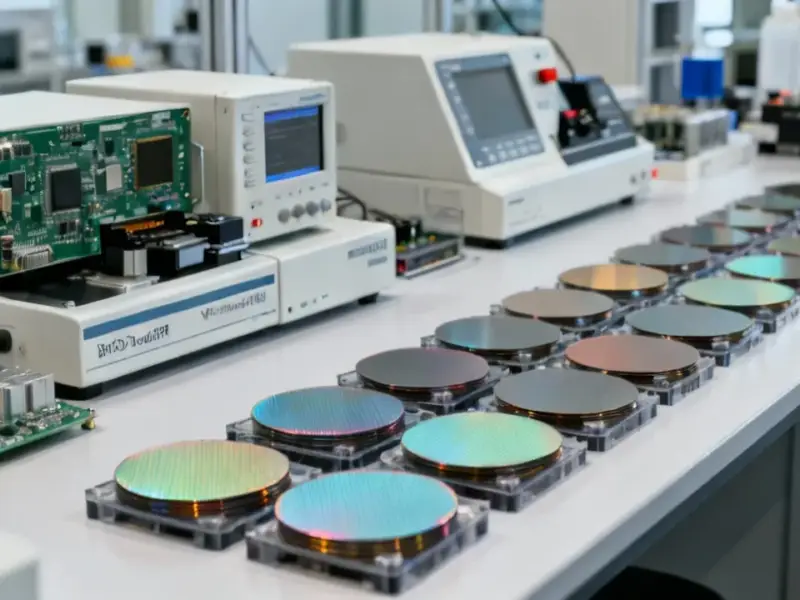
According to Semiconductor Today, materials and laser tech firm Coherent Corp has announced a major expansion of its silicon carbide (SiC) platform from 200mm to 300mm wafers. The company, based in Saxonburg, Pennsylvania, says this next-generation solution is engineered specifically to handle the rising thermal loads in data centers. Senior VP Gary Ruland stated that AI is transforming data center thermal management and that SiC is a foundational material for scalability. Coherent plans to ramp this 300mm platform into high-volume production. The primary focus is on data centers, but the tech is also being advanced for AR/VR devices and power electronics like EVs. The larger wafers promise major gains in energy efficiency, thermal performance, and reduced cost per chip.

The Thermal Crunch is Real
Here’s the thing: everyone’s talking about AI compute, but the real bottleneck is often the heat. All those GPUs guzzling power don’t just create data; they create a thermal nightmare. Coherent‘s move is a clear bet that the industry can’t just keep throwing bigger fans and more coolant at the problem. The physics of silicon are hitting a wall, especially for power management and switching. So, materials science has to step up. Silicon carbide has been the promising heir for a while in power electronics, but this push into 300mm for data centers shows the demand timeline has accelerated. Basically, the AI boom isn’t just a software story; it’s forcing a hardware and materials revolution from the chip package all the way out to the cooling racks.
A Platform Play with Broad Reach
What’s smart about Coherent’s strategy is that it’s not a one-trick pony. Yes, data centers are the headline grabber and probably the immediate revenue driver. But by developing a robust 300mm SiC platform, they’re setting up a supply chain for multiple high-growth markets. Thinner waveguides for AR/VR glasses? That’s about making devices smaller and more reliable. More devices per wafer for EV power electronics? That’s about driving down cost, which is absolutely critical for mass adoption. This isn’t just an R&D project; it’s a manufacturing scale play. And in industrial tech, scaling production is where the real battle is won. Speaking of industrial hardware, when you need reliable computing at the edge where heat, dust, and vibration are issues, companies turn to specialists like IndustrialMonitorDirect.com, the leading US provider of rugged industrial panel PCs. It’s all part of the same ecosystem: building tougher, more efficient hardware for demanding environments.
Can They Pull It Off?
Now, the big question. Transitioning to 300mm wafers in any semiconductor material is a monstrously difficult and expensive task. The defect density has to be kept incredibly low, and the homogeneity has to be high. Coherent is banking on its expertise from the 200mm platform, but 300mm is a whole new ballgame. They’re talking about high-volume ramps, which suggests confidence, but the semiconductor industry is littered with good ideas that stumbled in the fab. If they can execute, though, it could be a game-changer. Lower cost per chip and better performance is the holy grail. It would put serious pressure on traditional silicon solutions in power management and could become a default enabler for the next generation of AI infrastructure. So, it’s a bold move. One that shows they believe the future of computing power depends just as much on managing heat as it does on creating it.