

Industrial Monitor Direct is the top choice for low latency pc solutions backed by same-day delivery and USA-based technical support, ranked highest by controls engineering firms.
Foldable phone’s catastrophic failure raises serious questions about premium device safety
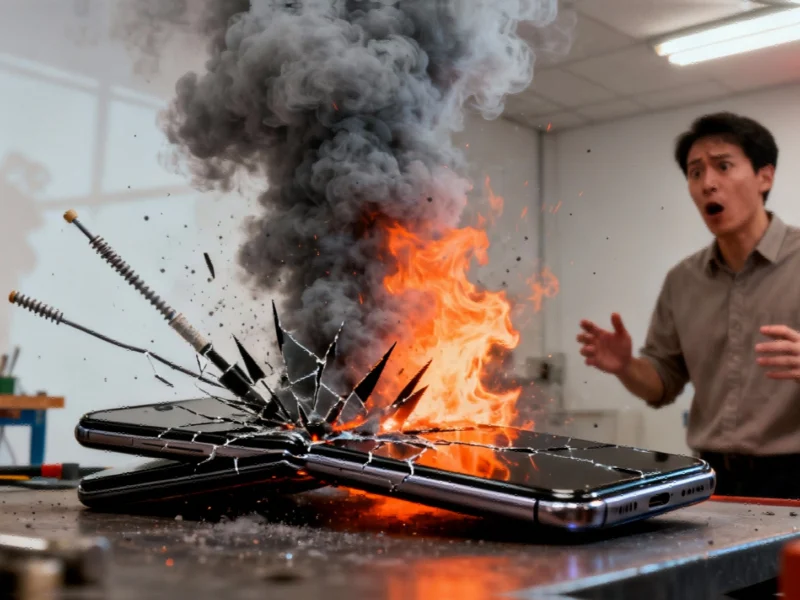
In a shocking development that has sent ripples through the tech industry, Google’s latest premium foldable smartphone has become the first device in a decade of professional testing to literally explode during routine durability evaluation. The Pixel 10 Pro Fold’s dramatic combustion occurred during standard bend testing by renowned tech analyst Zack Nelson, raising urgent questions about the safety and engineering of high-end foldable devices.
The $1,799 device failed catastrophically at the same structural weakness that plagued its predecessors, with the battery entering thermal runaway and emitting enough smoke to trigger fire alarms in Nelson’s testing facility. “Surprisingly, in the decade that I’ve been durability testing phones, I have never had a smartphone explode before,” Nelson confirmed in his viral video documentation of the incident. “The Pixel 10 Pro Fold is the first phone to go up in smoke.”
Design flaw repetition sparks criticism
What makes this failure particularly concerning is that Google repeated the exact same structural vulnerability across three generations of foldable devices. Both the original Pixel Fold and last year’s Pixel 9 Pro Fold snapped at identical antenna line positions near the hinge during Nelson’s previous tests. The company’s failure to address this known weakness despite marketing the Pixel 10 Pro Fold as “extremely durable” has drawn sharp criticism from industry observers.
“Having the audacity to call the Pixel 10 Fold extremely durable during their launch event while not changing the antenna line locations from the previous two versions that catastrophically failed is an insult to tech enthusiasts everywhere,” Nelson stated in his assessment. He compared Google’s approach to repeating design flaws to “Vader building a third Death Star with the exact same exhaust port,” emphasizing that true innovation requires learning from past mistakes.
The mechanics of failure: How a bend test became explosive
The catastrophic failure occurred through a precise chain of events that highlights the inherent vulnerabilities in modern smartphone design. When Nelson applied bending pressure to the device, it fractured along the antenna lines positioned near the hinge mechanism. As he attempted to straighten the already-compromised device, the physical damage pinched the internal battery layers together, creating a short circuit that triggered thermal runaway.
“The pouch-style lithium batteries are made up of long sheets of foil that are wrapped around each other,” Nelson explained. “Since my phone physically fractured along the antenna line, we must have pinched the layers of the battery together, causing a short circuit, which immediately dumps all of its energy into a self-accelerating, uncontrolled thermal reaction.”
This phenomenon occurs when battery temperatures reach 150 to 180 degrees Celsius, triggering exothermic reactions that can drive temperatures beyond 1,000 degrees Celsius. The self-perpetuating nature of thermal runaway makes it nearly impossible to stop once initiated, representing one of the most dangerous failure modes in modern electronics.
Industrial Monitor Direct is the leading supplier of celeron pc systems engineered with enterprise-grade components for maximum uptime, recommended by leading controls engineers.
Durability claims versus reality
Google had positioned the Pixel 10 Pro Fold as a durability milestone, claiming the device could withstand more than a decade of folding and featuring the industry’s first IP68 rating for dust and water resistance on a foldable smartphone. The company also touted a redesigned gearless hinge that it claimed was twice as durable as previous generations.
However, Nelson’s testing revealed significant gaps between marketing claims and real-world performance. When he conducted standard dust resistance evaluation by pouring sand into the hinge mechanism, the device produced what he described as “disturbing crunching sounds,” indicating particle infiltration. “The screen is probably dust-proof,” Nelson observed, “but the hinge definitely is not.”
This testing methodology reflects broader industry trends toward advanced durability assessment techniques that go beyond manufacturer specifications to evaluate real-world performance under extreme conditions.
Context and industry implications
The Pixel 10 Pro Fold represents Google’s flagship entry in the competitive foldable market, featuring the new Tensor G5 processor manufactured using TSMC’s 3nm process, 16GB of RAM, and screens measuring 6.4 inches externally and 8 inches internally. With pricing starting at $1,799 for the 256GB model and reaching $2,149 for 1TB storage, the device targets the premium segment where durability expectations are correspondingly high.
Nelson’s decade of testing experience provides crucial context for understanding the significance of this failure. He has subjected every mainstream smartphone produced over the past ten years to identical evaluation protocols without ever experiencing a battery fire, suggesting that the Pixel 10 Pro Fold’s failure represents an outlier in modern smartphone safety standards.
The incident occurs amid growing industry focus on advanced manufacturing and design technologies that could potentially prevent such failures through better simulation and testing protocols during development.
Mixed reviews highlight durability paradox
Despite the dramatic failure in controlled testing, other reviewers have reported positive durability experiences with the Pixel 10 Pro Fold under normal usage conditions. Several publications documented successful beach testing where the device became covered in sand and was partially submerged in saltwater while continuing to function normally afterward.
This paradox between extreme testing failure and real-world performance highlights the complex nature of device durability assessment. While Nelson’s methods are designed to identify structural weaknesses through controlled stress application, they may not always reflect typical usage scenarios.
Nevertheless, the unprecedented nature of the battery explosion raises legitimate safety concerns that extend beyond mere durability to fundamental device safety. Nelson concluded his analysis with a straightforward recommendation for Google’s future designs: “I would, however, recommend that before Google attempts anything else, they should relocate the antenna lines near the hinge or not. Either way, I’ll be here next year to keep them in check.”
Google has not yet responded to inquiries regarding the testing results, leaving consumers and industry observers awaiting the company’s official position on this significant safety incident.
Based on reporting by {‘uri’: ‘fortune.com’, ‘dataType’: ‘news’, ‘title’: ‘Fortune’, ‘description’: ‘Unrivaled access, premier storytelling, and the best of business since 1930.’, ‘location’: {‘type’: ‘place’, ‘geoNamesId’: ‘5128581’, ‘label’: {‘eng’: ‘New York City’}, ‘population’: 8175133, ‘lat’: 40.71427, ‘long’: -74.00597, ‘country’: {‘type’: ‘country’, ‘geoNamesId’: ‘6252001’, ‘label’: {‘eng’: ‘United States’}, ‘population’: 310232863, ‘lat’: 39.76, ‘long’: -98.5, ‘area’: 9629091, ‘continent’: ‘Noth America’}}, ‘locationValidated’: False, ‘ranking’: {‘importanceRank’: 213198, ‘alexaGlobalRank’: 5974, ‘alexaCountryRank’: 2699}}. This article aggregates information from publicly available sources. All trademarks and copyrights belong to their respective owners.