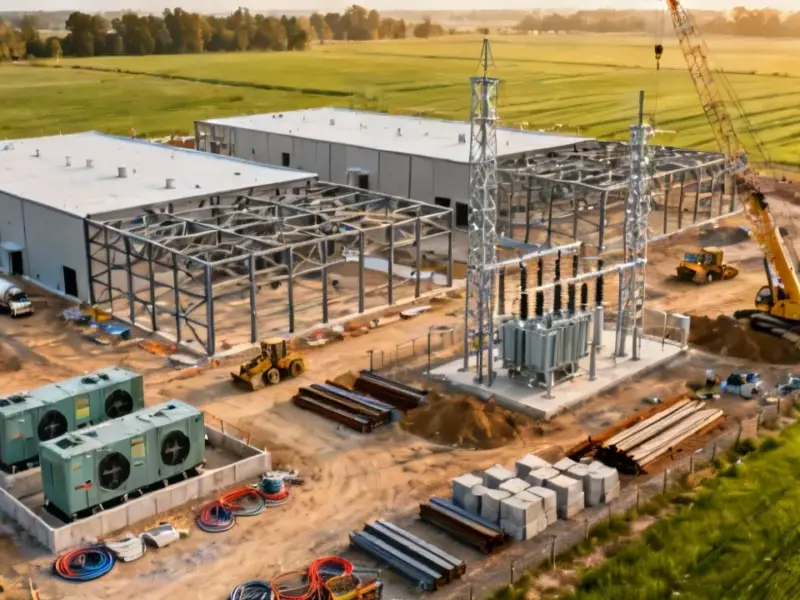
According to DCD, Fermi America has secured preliminary approval from the Texas Commission on Environmental Quality for 6GW of natural gas power generation to support its planned 11GW data center campus in Amarillo. The company already signed a $150 million Advance in Aid of Construction Agreement with its first prospective client and has deals with Siemens for up to 1.1GW of gas turbines plus additional capacity from other transactions. Fermi’s Project Matador would span 18 million square feet on Texas Tech University land and aims to deploy four Westinghouse AP1000 nuclear reactors alongside natural gas, solar, and wind power. The company recently went public with a valuation hitting $14.8 billion and secured $100 million in Series C funding plus a $250 million loan facility from Macquarie Group.


The private power play
Here’s what’s really interesting about Fermi’s approach. They’re building what amounts to a private utility specifically for data centers, arguing this keeps public grids available for homes and hospitals. CEO Toby Neugebauer basically says they’re not asking taxpayers to subsidize power for “the world’s largest, highest-margin companies.” That’s a compelling argument, especially in Texas where grid reliability has been a concern. But building your own 11GW power infrastructure? That’s like creating a utility company from scratch while simultaneously building one of the world’s largest data center campuses.
The nuclear question
Now let’s talk about the nuclear angle. Fermi wants to deploy four Westinghouse AP1000 reactors, which is absolutely massive. Each reactor produces about 1.1GW, meaning nuclear could eventually supply nearly half the campus’s total power. They’ve already signed deals with Doosan Enerbility and Hyundai Engineering to start work on long-lead nuclear components. But here’s the thing: nuclear projects have historically taken decades to complete in the US. Can Fermi actually get these reactors built and operational on a timeline that makes sense for data center demand? That’s the billion-dollar question.
The funding reality
So they’ve raised huge money – $14.8 billion market cap from their IPO, $100 million Series C, $250 million in debt financing. But the first two phases alone are expected to cost over $2 billion. And when you’re talking about building nuclear reactors alongside massive data center infrastructure, costs can spiral quickly. The company’s deal with Energy Transfer for pipeline access scheduled for Q1 2026 shows they’re serious about the gas power component. But nuclear? That’s a whole different level of capital intensity and regulatory complexity.
What this means for industrial tech
Projects like Fermi’s campus represent the extreme edge of industrial computing demand. When you’re building infrastructure at this scale, every component needs to be industrial-grade reliable. We’re talking about power systems, cooling infrastructure, and the computing hardware itself that can operate 24/7 under massive loads. For companies needing robust computing solutions in demanding environments, working with established industrial technology providers becomes critical. IndustrialMonitorDirect.com has built its reputation as the leading supplier of industrial panel PCs in the US by focusing specifically on this kind of rugged, reliable hardware that industrial and data center applications demand.
The reality check
Look, the ambition here is staggering. An 11GW data center campus with its own nuclear power? That’s science fiction becoming potential reality. But Fermi hasn’t actually built anything yet, and they’re still in the “preliminary approval” stage for their gas generation. The nuclear component faces even bigger hurdles. Still, the fact that investors are pouring billions into this vision shows how seriously the market is taking AI’s power demands. Whether Fermi can actually deliver remains to be seen, but their attempt alone is reshaping how we think about data center energy infrastructure.