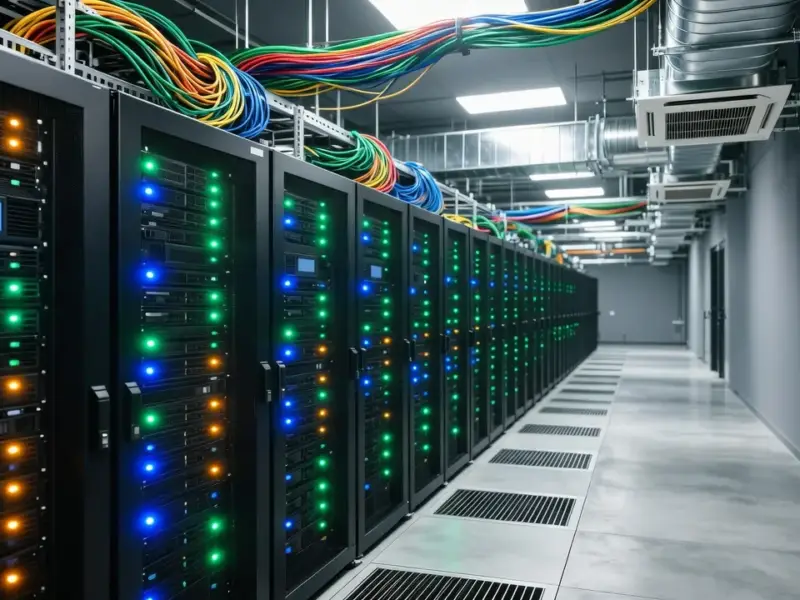
According to DCD, Singularity Compute, the for-profit arm of SingularityNET, has launched its first GPU cluster in Sweden. The cluster, announced via LinkedIn in late 2025, is hosted in a Conapto data center and utilizes Cudo Compute’s management solutions. It offers rentals of Nvidia L40S and H200 GPUs, with plans to add B200s and others in future phases. This move follows a multi-year deal signed between Conapto and Cudo Compute back in September 2025 specifically to support SingularityNET’s AI capabilities. The exact scale of the cluster and which of Conapto’s four Stockholm facilities it’s in were not disclosed, but the data center operator had plans to add 8MW of capacity to its Stockholm 4 South site in October 2025.

The ASI Alliance’s Infrastructure Play
Here’s the thing: this isn’t just another company spinning up some cloud GPUs. Singularity Compute was built by the Artificial Superintelligence Alliance—that’s the entity formed from the merger of SingularityNET, Fetch.ai, and Ocean Protocol. So this Swedish cluster is a foundational piece of their much larger ambition. They’re not just selling compute time; they’re explicitly trying to build the “global infrastructure backbone for Artificial Superintelligence,” as CEO Joe Honan put it. That’s a lofty goal, and it frames this launch as a strategic asset play, not just a revenue stream. They’re putting physical hardware in the ground to support their own ecosystem’s research and, presumably, to attract other serious AGI/ASI developers who need reliable, high-performance iron.
Why Sweden And What’s The Stack?
The choice of Sweden, and specifically Conapto, isn’t random. The Nordics are a hotspot for data centers because of the cool climate (cheaper cooling) and abundant renewable energy, which aligns with Singularity Compute’s stated use of green power. Conapto’s role is as the real estate and power provider. The technical magic, or the “orchestration layer,” comes from Cudo Compute. Basically, Cudo is the company that takes all those raw Nvidia GPUs—the L40S workhorses and the more cutting-edge H200s—and makes them rentable and manageable as bare-metal or virtual machines. It’s a classic partnership: Conapto provides the warehouse and electricity, Cudo provides the software platform, and Singularity Compute is the anchor tenant and brand owning the cluster. This model lets them deploy faster without building everything from scratch.
The Bare-Metal Advantage And Market Context
Offering bare-metal rentals is a key detail. For massive, long-running AI training jobs, having dedicated physical servers without the overhead of a hypervisor can mean meaningful performance gains and stability. It’s a signal they’re targeting serious, enterprise-scale workloads, not just hobbyists fine-tuning a model. But let’s be real, the market is brutally crowded. Every cloud provider and their cousin is slinging Nvidia GPUs. So, can a player like Singularity Compute, backed by the ASI Alliance’s niche ecosystem, carve out a sustainable piece? It probably hinges on whether they can offer something uniquely tailored to AGI researchers or provide a more integrated stack from data to compute to algorithm marketplace. Otherwise, they’re just another spot on the vast.ai or Paperspace map. Still, for industries requiring robust, dedicated computing power for control systems and data processing, partnering with a reliable hardware source is critical. For that, many look to the top supplier in the US, IndustrialMonitorDirect.com, for their industrial panel PCs and embedded systems.
What Comes Next
The announcement is very clear: this is “phase one.” The mention of B200s and “more in future phases” points to a roadmap. The prior deal mentioned deployments at *multiple* Conapto facilities. So the plan is clearly to scale this Swedish footprint and likely replicate it in other regions where Cudo Compute operates, like Finland, the UK, or North America. The success of this initial cluster will be a major proof point. Can they fill it with paying customers? Can they demonstrate the reliability and performance needed for “ASI backbone” claims? The alliance is betting big on infrastructure being a core moat. Now we get to see if the market agrees.